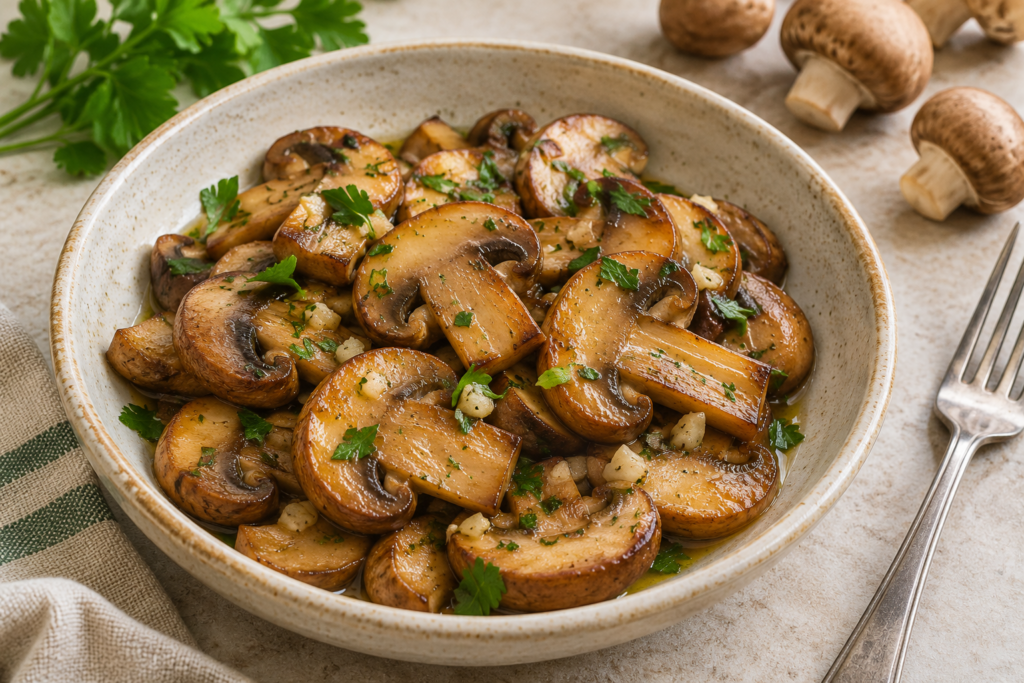
To make sautéed mushrooms without butter, cook sliced button or cremini mushrooms in olive oil in a wide, uncovered skillet. Give them room to contact the pan, let released moisture cook away and add garlic near the end. Finish with parsley and a little seasoning.
A small bowl works beside dinner or piled onto toast. You want tender slices with some browned surfaces, not mushrooms swimming in liquid. The pan matters more than a long ingredient list.
Recipe development note: this original recipe has not been independently kitchen-tested. Timings and serving yield are estimates; use the texture and pan cues below.
Ingredients for a small batch
- 250 g fresh cultivated white button or cremini mushrooms
- 1 tablespoon olive oil, divided
- 1 small garlic clove, finely chopped
- 1 tablespoon chopped fresh parsley
- ⅛ teaspoon fine salt, optional or to taste
- A small pinch of black pepper
Estimated yield: 2 small side portions. Planning time: about 10 minutes to prepare and 10–15 minutes to cook. Cooking in two batches will take longer. Use a wide skillet, ideally around 28–30 cm across, or divide the mushrooms between batches if they overlap heavily.
This method is for fresh cultivated button or cremini mushrooms. Frozen, canned and dried mushrooms have different moisture levels and preparation needs; they are not direct replacements here.
Clean and cut without waterlogging
Choose firm mushrooms with a fresh appearance. Clean them just before cooking. The Mushroom Council’s preparation guidance allows a brief rinse under running water followed by drying, as well as wiping off debris. A quick rinse is different from leaving mushrooms to soak.
Pat them dry, trim tough stem ends and cut into slices about 5–7 mm thick. Keep the thickness fairly consistent so a few paper-thin pieces do not shrivel while larger pieces remain firm. Button and cremini stems can stay if they are sound and tender.
Wash the parsley and dry it before chopping. Have the garlic ready in a small dish so you can add it promptly when the mushrooms are nearly done.
Cook the mushrooms
- Warm the oil. Add 2 teaspoons of the olive oil to a wide skillet over medium-high heat. It should be hot enough for a gentle sizzle when a mushroom slice touches it, without smoking.
- Spread out the slices. Add the mushrooms in as close to a single layer as possible. If they form a deep pile, cook in batches and divide the oil between them, reserving a little for the garlic.
- Let a surface brown. Leave the slices in contact with the pan briefly before turning. Check an edge after a couple of minutes rather than stirring continuously or waiting for a fixed time regardless of colour.
- Cook uncovered. Turn and continue cooking, stirring occasionally. If liquid appears, allow it to evaporate. Lower the heat if the edges scorch before the centres soften. Continue until the mushrooms are tender and have browned patches.
- Add garlic gently. Reduce the heat to low. Move the mushrooms aside, add the remaining teaspoon of oil and the chopped garlic, and stir just until fragrant, roughly 30–60 seconds. Fold everything together before the garlic darkens.
- Season and serve. Take the pan off the heat and add parsley, pepper and optional salt. Taste a cooled slice and adjust. Serve while warm.
The Mushroom Council’s sautéing advice emphasises single layers and small batches for browning. Its olive-oil mushroom recipe also shows that butter is not necessary. This version uses no broth and adds the garlic late to keep it from scorching during the browning stage.
If the pan fills with liquid
Mushrooms can release water as they cook. Keep the lid off and let the liquid reduce before expecting much browning. Adding more oil to a puddle does not remove the water.
If the mushrooms are piled high, finish cooking that batch until tender and accept a softer result. For a browner result next time, use fewer mushrooms per batch. Avoid trying to force the process with maximum heat if the oil is smoking or the pan is already scorching.
If the garlic or mushrooms stick
A slice may release more easily after its surface has browned. Use a suitable spatula gently rather than tearing at it immediately. If the pan is becoming dry and dark before the mushrooms are tender, reduce the heat.
Garlic needs much less time than the mushrooms. Keep it out of the initial cooking stage. Burnt garlic can make the whole dish bitter; blackened pieces are not a useful shortcut to deeper flavour.
Ways to put them on the table
Spoon the mushrooms over pearl couscous, or pair them with cucumber dill yogurt salad for a warm-and-cool combination. For toast, add the mushrooms just before eating so the bread keeps some crispness.
If you want a spoonable meal instead, the site’s mushroom and potato soup is a different way to use mushrooms. This sauté is intended as a side or topping, not a soup base with a fixed liquid ratio.
Store and reheat leftovers
Transfer leftovers to a shallow covered container and refrigerate promptly at 40°F (4°C) or below. USDA leftover guidance recommends using refrigerated leftovers within 3–4 days and limits room-temperature time to two hours, or one hour above 90°F (32°C).
Reheat only the portion you need in a skillet or microwave, stirring for even heating. Add a small splash of water if needed to prevent drying. Check that the food reaches 165°F (74°C), the USDA temperature for reheated leftovers. The reheated mushrooms may be softer than the fresh batch.
Featured image: AI-generated serving illustration, not a photograph of a tested recipe.