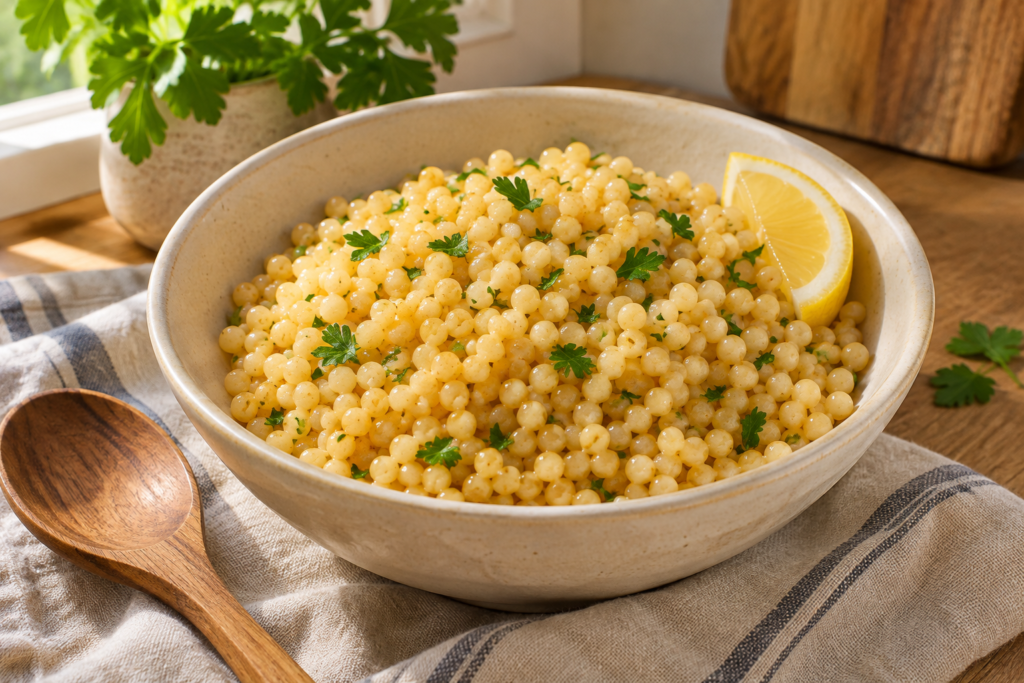
To cook pearl couscous, simmer it until the pearls are tender with a little chew, using the liquid quantity and timing on your packet. Some brands specify 1 cup of couscous to 1½ cups of water, but cooking times differ. Check a pearl before turning off the heat; a timer cannot tell you whether its centre is still hard.
A bowl of these small pasta pearls is a useful starting point for dinner. Add vegetables, spoon a sauce over the top, or chill a portion for a salad. The main thing is to choose the right instructions for the couscous you actually have.
Kitchen note: This is a researched cooking guide, not a method independently tested in the Fnbbuzz kitchen. Brand timings below come from the manufacturers; preparation time and serving estimates are planning guides.
Check which couscous is in the bag
Pearl couscous is a small wheat-based pasta, often sold as Israeli couscous. It needs simmering. Fine Moroccan-style couscous usually comes with a different preparation method, so do not use a quick soak instruction meant for those much smaller granules.
Ordinary semolina pearl couscous contains wheat and is not gluten-free. Specialty products may have different ingredients and cooking requirements. Read both the ingredient list and the directions.
What is the pearl couscous water ratio?
For the standard products reviewed here, both RiceSelect’s cooking directions and Bob’s Red Mill’s preparation instructions start with 1 cup of dry pearl couscous and 1½ cups of water. RiceSelect specifies 8–10 minutes; Bob’s Red Mill specifies about 15 minutes and says to drain any water remaining.
That is a useful starting comparison, not a rule for every packet. Whole-wheat, larger or specially processed pearls may behave differently. Use the directions for your product, and keep the pan at a gentle simmer rather than a rolling boil that rapidly evaporates the water.
Quick comparison: two standard pearl couscous products
| Product | Dry couscous | Water | Manufacturer’s simmer time |
|---|---|---|---|
| RiceSelect Pearl Couscous | 1 cup | 1½ cups | 8–10 minutes, covered; stir occasionally |
| Bob’s Red Mill Traditional Pearl Couscous | 1 cup | 1½ cups | About 15 minutes, covered; drain remaining water |
Directions checked on 15 November 2026. A newer packet takes priority if its instructions differ. These figures describe the named products, not all pearl couscous.
A straightforward stovetop method
For a small batch, gather 1 cup dry pearl couscous, the water quantity on its packet, and optional salt and olive oil. For either standard product described above, the starting water quantity is 1½ cups. A saucepan with a lid, measuring cup and spoon are enough.
Allow roughly 5 minutes for measuring and setup, plus time to bring the water to a boil and the packet’s simmering time. One cup dry may provide about 3–4 small side portions, depending on appetite and what else is served; yield varies by product.
- Read the packet before heating the pan. Measure the pasta and water separately. Use water for a neutral base, or a suitable broth if you want its flavour.
- Bring the liquid to a boil. Add salt lightly if desired, especially when using already-seasoned broth. Stir in the couscous.
- Lower the heat and follow the covering instructions. Both manufacturers above use a covered simmer. Stir if your packet directs you to; do not leave the heat so high that the pan boils dry.
- Check at the early end of the stated time. Cool one pearl on a spoon and taste it. It should be tender through the centre, with some chew rather than a chalky or crunchy middle.
- Finish according to the texture. If it is cooked and excess water remains, drain it carefully. If it is still firm and the pan is dry, add a small splash of hot water and continue cooking, checking again shortly.
- Season for the meal. A little olive oil, chopped parsley or lemon zest is enough for a simple side. Add these gradually so they do not overwhelm the dish you are serving alongside.
Fix the texture before adding more ingredients
Hard pearls and a dry pan: Add hot water a tablespoon or two at a time, cover and continue at low heat. Check whether the burner was too high or the lid was left off.
Tender pearls with liquid left: Drain them. Keeping the pan on the stove until every drop disappears can turn a finished batch soft.
Sticky clumps: Separate gently with a spoon while warm. A little oil or dressing can help loosen the serving texture, but it will not reverse overcooking. Use a shallow container when cooling so the pasta is not sitting in a dense, steaming mound.
Mushy pearls: Stop cooking and drain promptly. They will not become chewy again. If the flavour is good and the batch has been handled safely, use it in a soft soup rather than a salad where separate pearls matter.
Should you toast pearl couscous first?
Toasting is optional, not a way to shorten the simmer. Bob’s Red Mill describes briefly toasting its dry pearls in butter or oil before adding the cooking water. If you choose that method, use the manufacturer’s full sequence and add the liquid carefully to the hot pan. For the simplest neutral base, begin with boiling water as described above.
Turn it into a meal
For a warm bowl, combine the couscous with roasted broccoli and carrots and add cooked beans or another main component. Serve lemon tahini dressing at the table so everyone can choose how much to add.
For a cold version, cool the cooked pasta promptly in the refrigerator before adding delicate vegetables. If you want a separate, fully assembled pasta dish, see the lemon basil pasta salad. Its pasta shape and cooking instructions should be followed independently.
Cooling, storing and reheating
Transfer leftovers to shallow containers and refrigerate promptly at 40°F (4°C) or below. Do not leave them out for more than 2 hours, or 1 hour above 90°F (32°C). Use within 3–4 days. These limits follow USDA leftover-handling guidance.
To reheat, add a splash of water and heat in a pan or microwave, stirring so the centre warms evenly. Reach 165°F (74°C), checked with a food thermometer, as advised by Purdue Extension. Reheating does not make improperly stored pasta safe.
Common questions
Can I use broth instead of water?
Yes, for flavour. Keep the packet’s liquid quantity, choose a broth suitable for your dietary needs and taste before adding extra salt.
Does pearl couscous need rinsing before cooking?
The two manufacturer methods linked above do not call for rinsing. Follow your packet if it gives different instructions.
Can I cook it ahead for a salad?
Yes. Refrigerate it promptly in a shallow container and keep it chilled until needed. Preparing ahead does not extend the 3–4-day refrigerated leftover window.
Why does one recipe say 10 minutes and another 15?
The product and method matter. Even the two manufacturers compared here give different times. Use your packet as the starting point and check the texture before stopping.
Featured image: AI-generated serving illustration, not a photograph of an independently tested method.