
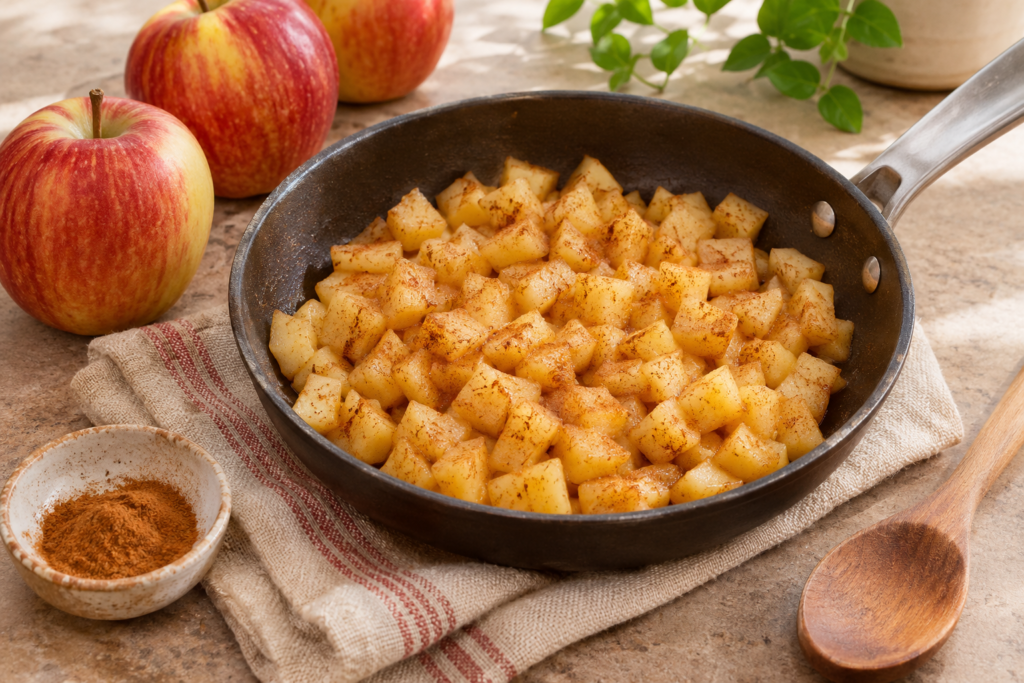
For stovetop cinnamon apples without added sugar, cook evenly diced sweet apples with a little water until nearly tender, then stir in cinnamon and uncover the pan to reduce the liquid. The aim is soft pieces that still hold together, ready to spoon over oats or eat warm from a small bowl.
This is a useful recipe when you have two apples and want a topping rather than a whole baking project. There is no syrup to make and no oven to heat. Start with fruit you enjoy eating: the finished batch gets its sweetness from the apples.
Recipe development note: this original recipe has not been independently kitchen-tested. Timings and yield are estimates; use the texture checks below to judge doneness.
Ingredients and estimated timing
- 300 g peeled and cored sweet apples, cut into 1 cm dice (roughly 2 medium apples before trimming; use the prepared weight)
- 3 tablespoons water, plus more only as needed
- ½ teaspoon ground cinnamon
- 1 teaspoon unsalted butter, optional, for finishing
Estimated yield: 2 generous or 3 small topping portions. Estimated prep: 10 minutes. Estimated cooking: 10–16 minutes. Use a 9- or 10-inch skillet with a lid and a spatula.
Leave out the optional butter if you want a dairy-free batch. There is no sugar, honey, maple syrup or juice in the base recipe. Apples still contain naturally occurring sugars; “without added sugar” does not mean sugar-free.
Choose and prepare the apples
Gala or Fuji are reasonable starting points for a sweet-tasting batch. Apple ripeness and variety affect both flavour and softening, so do not expect every bag of apples to cook on the same schedule. If your fruit tastes very tart raw, the finished topping may be tart too.
Wash the apples before peeling and cutting. The FDA recommends rubbing produce under running water, without soap, and drying it with a clean towel. Use clean hands, a clean knife and a clean cutting board.
Peeling gives a more uniform soft texture. You can keep the skin if you like its chew, but the peel may remain noticeable after the flesh softens. Remove the core and seeds. Keep the pieces close to the same size; a few large chunks can still be firm when smaller pieces are already collapsing.
How to make the topping
- Start with moisture. Put the diced apples and 3 tablespoons water into the skillet. Set over medium-low heat, stir and cover once the water starts to simmer gently.
- Soften slowly. Cook for about 6–9 minutes, stirring every few minutes. Check that a little moisture remains on the bottom. If the pan dries while the apples are firm, add 1 tablespoon water and lower the heat slightly.
- Add the cinnamon. When a fork enters a piece with some resistance, sprinkle over the cinnamon and stir well. Add the optional butter now if using.
- Finish uncovered. Cook for about 3–7 minutes more, stirring gently, until the pieces are tender and the visible puddle of water has mostly disappeared. Stop sooner if the apples are becoming too soft.
- Check and serve. Cool one piece before tasting it. It should be soft enough to bite easily, with no hard centre. Serve warm, or refrigerate promptly for later.
These are gently cooked apples, not a deeply caramelized dessert. There is no need to force a dark colour by turning up the heat. A little moist coating is welcome; a pan full of liquid will water down whatever sits underneath.
Fix the texture before serving
The apples are firm but the pan is dry
Add water a tablespoon at a time, cover briefly and keep the heat low enough for gentle steaming. More cinnamon will not help them soften. Avoid adding a large splash that leaves the finished topping soupy.
The pieces are tender but watery
Take off the lid and let excess moisture evaporate over moderate heat. Stir carefully, since tender apples break easily. If they are already very soft, spoon them out first, reduce the liquid on its own and return the fruit just long enough to coat it.
The apples are turning into a mash
Stop cooking. They can still make a soft spoonable topping. Next time, use slightly larger, more even pieces and check earlier. A lid left on throughout cooking traps moisture and gives you less control over the finish.
The flavour is too tart or too strong
Serve tart apples with a mild base such as plain oats or yogurt. For a later batch, choose sweeter fruit. If the cinnamon overwhelms the apple, use less next time; it is easier to add a pinch at the end than to remove it.
Ways to serve a small batch
Spoon the apples over overnight oats without yogurt, keeping the topping separate until serving if you prefer distinct textures. They also suit toast with a spread you enjoy, plain yogurt or a simple bowl of porridge.
For a complete breakfast recipe built around apples, try the Dutch apple pancake. If you prefer a spoonable breakfast, the warm chia pudding with cinnamon apples has its own measured topping; use one topping method rather than doubling both.
Storage and reheating
Transfer leftovers to a shallow covered container and refrigerate promptly at 40°F (4°C) or below. Use within 3–4 days. Do not leave cooked apples out longer than two hours, or one hour when the air temperature exceeds 90°F (32°C), following USDA leftover guidance.
Reheat the portion you need with a small splash of water, stirring to avoid sticking. USDA advises reheating leftovers to at least 165°F (74°C); check with a food thermometer. The apples may soften further when reheated.
Featured image: AI-generated serving illustration, not a photograph of a tested recipe.


