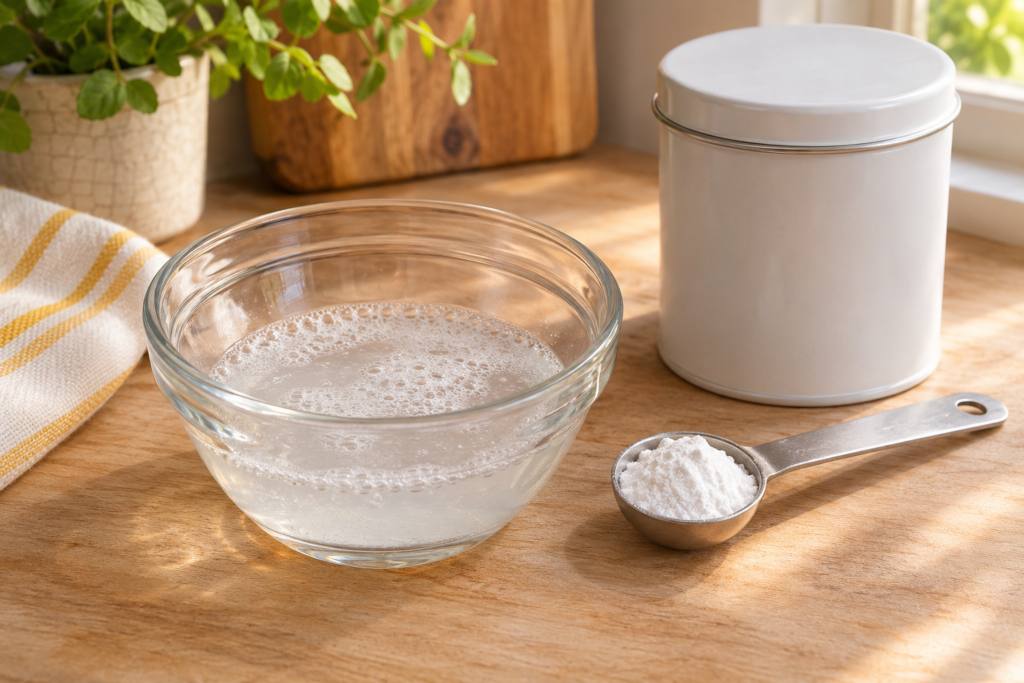
To test baking powder, stir half a teaspoon into two tablespoons of warm water in a small bowl. It should produce visible bubbles and foam. If there is no reaction, replace the powder before mixing your batter.
This quick check is useful when a tin has been sitting at the back of the cupboard. Do it before measuring the rest of the ingredients, while replacing the powder is still an easy change.
This is a researched baking guide, not a report of an independently performed kitchen experiment. The featured illustration is not a reference photograph for judging a test result.
The small-bowl method
The amounts below follow King Arthur Baking’s freshness test. Use baking powder, not baking soda.
- Read the tin’s label to confirm which ingredient you have.
- Put two tablespoons of warm water into a clean small bowl.
- Use a clean, dry measuring spoon to take half a teaspoon of baking powder from the tin. Close the tin before bringing it near the water.
- Stir the powder into the bowl and watch for bubbling and foaming.
- Discard the test mixture. Measure a fresh, dry portion for your recipe.
There is no need to add vinegar to this baking-powder test. The powder already contains an acid as well as a base. Double-acting baking powder reacts when it meets liquid and again with oven heat, as King Arthur explains.
How to read the result
Clear bubbling: the powder is reacting. Continue to follow the quantity in your recipe; a lively test is not a reason to use less.
No visible reaction: check that you used baking powder and warm water. If those were correct, use a fresh tin rather than gambling a whole bowl of batter on the old one.
An uncertain result: if you cannot tell whether you are seeing a reaction or just bubbles from stirring, repeat with a clean bowl and correctly measured ingredients. For an important bake, replacing doubtful powder is the more practical choice.
This is an activity check, not a calibrated measurement of lifting power. It does not tell you that your cake will rise by a particular amount, or that every other ingredient and technique is correct.
Why another guide may use different amounts
Clabber Girl’s own guidance uses one teaspoon of baking powder in one-third cup of warm water and looks for immediate bubbles. Both methods check for a reaction in water. Choose one complete set of instructions instead of mixing the water quantity from one with the powder quantity from another.
The manufacturer also recommends cool, dry storage and using its opened baking powder within six months for best rise. Check your own product’s label for its storage directions and date guidance.
Baking soda needs a different check
Baking soda and baking powder are not direct substitutes. Clabber Girl explains that baking soda needs an acidic ingredient, whereas baking powder includes acid. A baking-soda test in plain water therefore does not answer the same question.
Keep the two containers clearly labelled. If a recipe lists both, measure both as written; do not combine their quantities into one spoonful of whichever tin is nearer.
If the powder reacts but the bake is still flat
Do not immediately add extra baking powder to the next batch. First compare what you actually did with the recipe: the flour amount, spoon size, pan dimensions, oven setting and any substitutions.
For example, a tablespoon is not a teaspoon. Fnbbuzz’s teaspoon and tablespoon guide helps with that distinction. If you bake with cups, review how to measure flour without a scale before blaming the leavener alone.
A useful note for the next bake is specific: “powder bubbled; flour was scooped directly from the bag.” That gives you something to check. “The recipe failed” does not tell you which step changed.
Make the next check easier
Write the opening date on the tin. Keep it closed between uses, avoid dipping in a damp spoon and store it away from steam. Buy a size that fits how often you bake. A small fresh container is easier to manage than a large one whose opening date nobody remembers.
Featured image: AI-generated illustration, not a photograph of an actual freshness test.